According to the survey, conducted by the Sociological Group "Rating" in December 2010, almost 45% of citizens agree with the thesis that revolutionary moods are brewing in Ukraine, 13% of them definitely think so and 31% rather agree than disagree with the statement.
In turn, 41% of respondents disagree with the thesis that that revolutionary moods are brewing in Ukraine, 11% of them definitely disagree and 30% - rather disagree. 15% of respondents are undecided on the matter.
In the West and in the Centre of Ukraine people agree with the thesis that revolutionary moods are brewing in Ukraine the most, in particular 73% of supporters of Freedom, 67% - of Batkivshchyna, 59% - of the Front for Change and 55% - of V. Klitschko’s party “UDAR”. Residents of the North, the East, the South and Donbas rather agree than disagree with the statement, in particular supporters of the Party of Regions, Communists and Strong Ukraine.
More than a third of surveyed citizens (37%) believe that revolutionary moods may lead to mass protests in the nearest future (like events of November 2004).
46% of respondents do not believe in this. 17% of respondents are undecided on the matter.
The most radical are supporters of Batkivshchyna (58% believe in the recurrence of events of 2004), Freedom (56%) and the Front for Change (52%), they are mainly residents of the West and the Center of Ukraine.
Voters of the Party of Regions (23%) believe that revolutionary moods may lead to mass protests like events of November 2004 the least. Notably, residents of Donbas (33%) believe in the radicalization of the situation more than respondents in the South (30%) and in the East (28%).
It should be mentioned that there are two times fewer respondents who strongly believe in the radicalization of the protests, than there are those who rather assume it. Overall only one in ten Ukrainians is sure that revolutionary moods are definitely brewing in Ukraine and the majority of them believe that these attitudes may lead to mass protests like the events of November 2004. In particular, it is almost every fifth supporter of Batkivshchyna, Front for Change, and every fourth supporter of Freedom.
Most respondents (47%) believe that such massive protests in Ukraine are more possible on a social basis (protests caused by low living standards, etc.) and only 7% believe they are possible on a national basis (protests caused by disparagement of national interests, etc). Another quarter believes that protests are equally possible both on the social, and on the national basis. Every fifth respondent could not answer the question.
Residents of the North (the first place, Kyiv residents, who were able to follow and take part in recent entrepreneurs’ protests) - 56%, of the East - 52% and of the Centre - 51% believe in protests on the social basis the most. Residents of the West believe in protests on the social basis the least; more than one third of respondents there assume that protests are equally possible both on the social basis and on the national basis. Protests on the national basis are more expected by residents of the South (twice as much as in any other region). In the South, we are apparently dealing with a manifestation of an "ideological fear."
Supporters of the Front for Change, Batkivshchyna, Strong Ukraine and the Party of Regions believe in the possibility of protests on the social basis the most; supporters of Freedom (half of them believe that protests are equally possible on the social and on the national basis) believe it the least.
Almost a third of respondents (31%) believe that Y. Tymoshenko could lead the protest movement in Ukraine in case of such mass actions, 15% believe the leader could be A. Yatsenyuk, 14% - O. Tiahnybok. V. Klitschko (5%), V. Yushchenko (2%), A. Hrytsenko (2%) etc. were also mentioned but more rarely. A quarter of respondents believe that none of the above mentioned politicians are able to lead such a protest movement.
Y. Tymoshenko as a possible leader of the protest movement was mentioned in the North (41%), in Donbas (38%), in the West (32%) and in the Center (30%) the most often; A. Yatsenyuk – in the West (21%) and in the Center (21%), O. Tiahnybok – in the West (27%) and in Donbas (19%).
Y Tymoshenko was often mentioned by supporters of Batkivshchyna and the party “UDAR” as well as Strong Ukraine and the Party of Regions. A. Yatsenyuk – by supporters of Front for Change and Freedom, A. Tiahnybok – by supporters of Freedom and Front for Change.
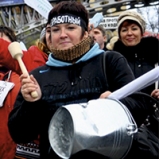
The vast majority of respondents (60%) believe that business protests against the new Tax Code (in particular, those which occurred at the Independence Square in Kiev) were the action of protest against governmental actions, which is not associated with politics. Nevertheless, nearly a quarter (22%) believes that it is more a political action. 18% of respondents are undecided on the issue.
The action of protest against the new Tax Code is recognized to be mainly non-political in each region of Ukraine. The majority of citizens, who do not associate entrepreneurs’ protests with politics, is in the North (73%), particularly in Kiev, where key events actually took place, and in the Centre (69%).
At the same time, nearly a third of supporters of Strong Ukraine and the Party of Regions believe that these protests are a political action.
The target audience of the research: the population of Ukraine aged from 18 and older. Optional quantity: 2000 respondents. The methods of investigation: personal formalized interview according to the questionnaire (face to face). Measure of inaccuracy for the values close to 50% is less than 3%, for the values close to 30% – less than 2,6%, for the values close to 10% – less than 1,8. The period of completion: 11-18 of December 2010
The oblast’ distribution:
West: Volyns’ka, Transcarpathia, Ivano–Frankivs’ka, L’vivs’ka, Rivnens’ka, Ternopil’s’ka, Chernivets’ka.
Centre: Vinnyts’ka, Kirovograds’ka, Poltavs’ka, Khmel’nyts’ka, Cherkas’ka.
North: Kyiv, Kyivs’ka, Zhytomyrs’ka, Sums’ka, Chernihivs’ka.
South: AR Crimea, Odes’ka, Khersons’ka, Mykolaivs’ka, Sevastopol
East: Dnipropetrovs’ka, Zaporiz’ka, Kharkivs’ka.
Donbass: Donets’ka, Luhans’ka.