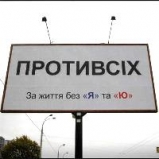
According to results of researches conducted by the Sociological group "Rating" in the course of previous three years, the number of respondents who intend not to support any of the parties (vote "against all") in parliamentary elections is increasing dynamically.
Thus, in the middle of 2009 about 8% of voters intended to vote "against all", 5% - before presidential elections. In the first round of presidential elections 2.2% voted "against all", while in the second round - 4.4%.
Immediately after presidential elections the number of "against all" respondents decreased to 2%, and since summer 2010 it continues to grow incessantly: in June 2010 - 5%, in October 2010 - 8%, in March 2011 - 10%, in May 2011 - 12%, and finally in September 2011 - 13% of voters. It should be noted that the mentioned figures are among respondents who intend to participate in elections. Among all respondents the "against all" index is even higher.
Also, the number of respondents who have no intention to vote during elections has increased from 16 to 26% since last October.
The number of voters who intend to participate in elections, but have not decided on their choice has also increased. However, in 2009-2010 the number of such respondents stably exceeded the number of "against all" respondents, while in 2011, for the first time, the number of "against all" respondents stably exceeds the number of "undecided" respondents.
Analysis results show that "against all", citizens who have no intention to vote in elections and "undecided" categories were mostly supplemented to by former supporters of the Party of Regions and Strong Ukraine.
The structure of "protest" electorate, more than half of which is in the South-Eastern region, namely in the East and in Donbas, serves to support this notion.
In turn, the West forms the "undecided" category by quarter. Also a quarter of this category is formed by Donbas.
Men are more likely to vote "against all" or to ignore elections, women - mostly "undecided." The majority of "against all" are in cities, "undecided" - in villages. A considerable part of the "against all" group and those who do not intend to participate in elections are young people. Unemployed citizens are more likely to vote "against all" or to ignore elections, citizens who are employed are more likely to be in the "undecided" category. The category of "undecided" has a higher level of education and income than the "against all" category.
Only every fifth (21%) among those who intend to come to elections and vote "against all" is considering the possibility to change his position and vote for a particular party. More than a half do not even consider this option, and 27% - have not decided yet.
If, according to the new election law, they will not be able to vote "against all", 35% of them intend to ignore elections. 42% - have not decided yet, and the rest - can vote for specific parties, in particular, mostly for Front for Change (5.4%), the Party of Regions (4.8%), the CPU (3%), UDAR (2.8%) and Civil Position (1.8%).
It should be noted that none of leading politicians can expect more than 15% of confidence from the "against all" category. V. Klitschko (14% of "against all" respondents trust this politician), A. Yatsenyuk (13%) and A. Hrytsenko (11%) have the biggest chances to win at least a part of their favors. V. Yushchenko (1%), O. Tiahnybok (3%) and Y. Tymoshenko (5%) are the least trusted by "against all" respondents.
The "undecided" category is less categorical in its attitude to politicians. A third of them trust V. Klitschko, almost every fifth - A. Yatsenyuk, V. Yanukovych and A. Hrytsenko, every sixth – Y. Tymoshenko.
People who vote "against all" during elections are acting like this because they do not trust politicians (52%) and do not trust any political power as such (45%).
One third vote "against all" because they are disappointed in their previous sympathies, thus expressing protest (31%), not having anyone to vote for (29%) or not wanting to have their vote stolen (23%).
However, every fifth believes that his vote does not solve anything, 8% - do not know whom to vote for, 6% - have no understanding of politics, 4% - vote "against all" because others do.
According to 69% of respondents, voting "against all" is a conscious choice (a principal position), only 20% believe that it is reluctance to take responsibility for their choice. 11% - have not decided on this matter.
It should be noted that the opinion of the conscious choice mostly prevails in the North (76%) and in Donbas (74%).
Except the majority of "against all" (88%), this opinion is also shared by citizens who will not participate in elections (72%) and by supporters of the CPU (72%).
At the same time, the idea of reluctance in taking responsibility for their choice is mostly shared among supporters of Freedom (32%), the Party of Regions (27%) and Batkivshchyna (26%).
However, 65% of respondents believe that the "not to participate in elections" position is also a conscious choice (a principal position) and only 23% think it is unwillingness to take responsibility for the choice. 12% - have not decided about this matter.
Again, the category "against all" shares the position of a conscious choice most of all (81%), as well as citizens who have no intention to take part in elections (70%).
Supporters of Batkivshchyna (28%), Freedom (32%) and the Party of Regions (32%) share the opinion of unwillingness to take responsibility for the choice.
Thus, positions "not to participate in elections" and "against all" are quite similar.
However, people who have no intention to take part in elections, do so primarily because there is no one to vote for. Yet, the "against all" category does not trust political power as such. In this lies the main difference between these two categories. And it is a quite clear and dangerous signal not only to the government, but to the opposition as well. And to society in general.
The target audience of the research: the population of Ukraine aged from 18 and older. Optional quantity: 2000 respondents. The methods of investigation: personal formalized interview according to the questionnaire (face to face). Measure of inaccuracy for the values close to 50% is less than 2,2%, for the values close to 30% – less than 2%, for the values close to 10% – less than 1,3. The period of completion: 17-27 of September 2011
The oblast’ distribution:
West: Volyns’ka, Transcarpathia, Ivano–Frankivs’ka, L’vivs’ka, Rivnens’ka, Ternopil’s’ka, Chernivets’ka.
Centre: Vinnyts’ka, Kirovograds’ka, Poltavs’ka, Khmel’nyts’ka, Cherkas’ka.
North: Kyiv, Kyivs’ka, Zhytomyrs’ka, Sums’ka, Chernihivs’ka.
South: AR Crimea, Odes’ka, Khersons’ka, Mykolaivs’ka, Sevastopol
East: Dnipropetrovs’ka, Zaporiz’ka, Kharkivs’ka.
Donbass: Donets’ka, Luhans’ka.